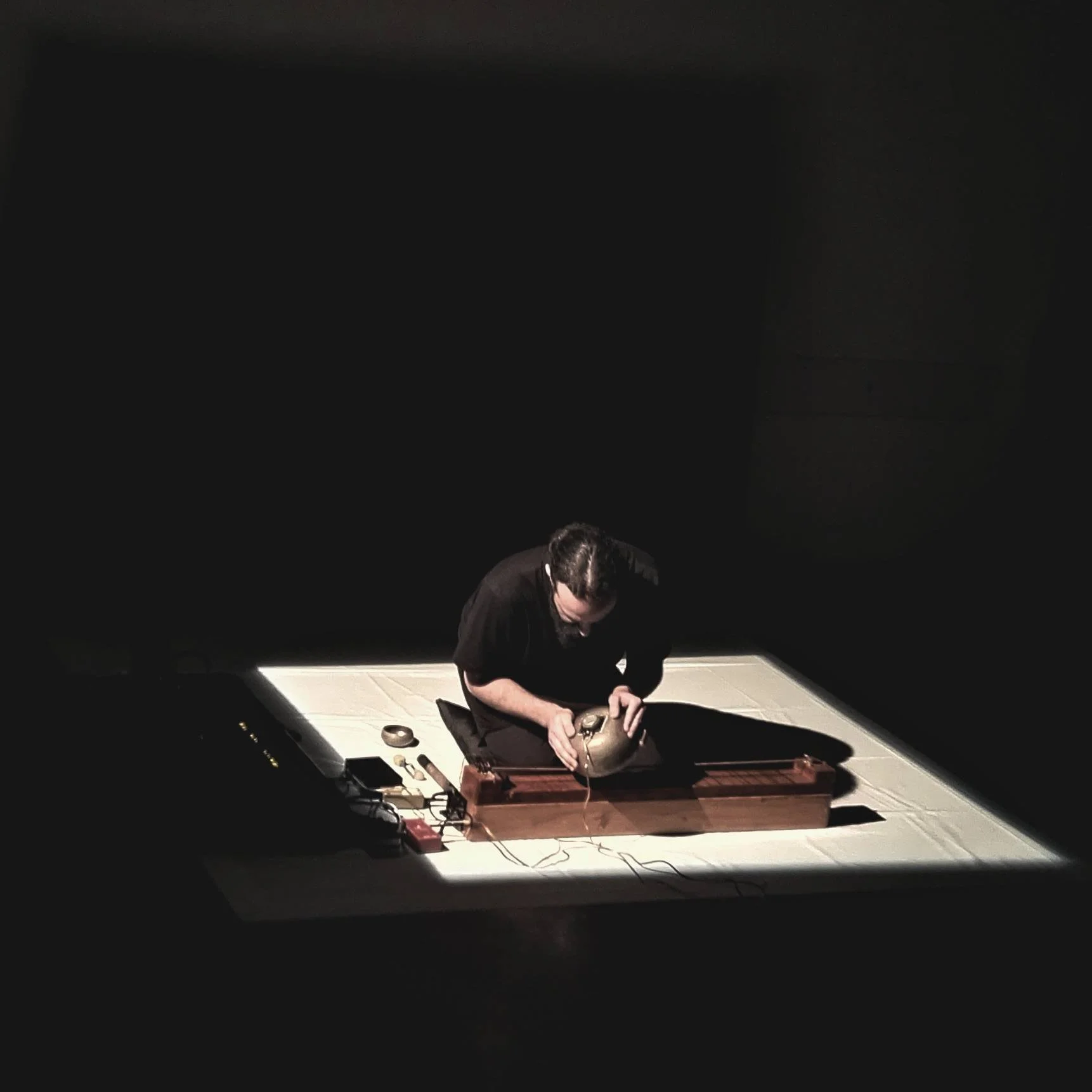
Massimiliano Cerioni
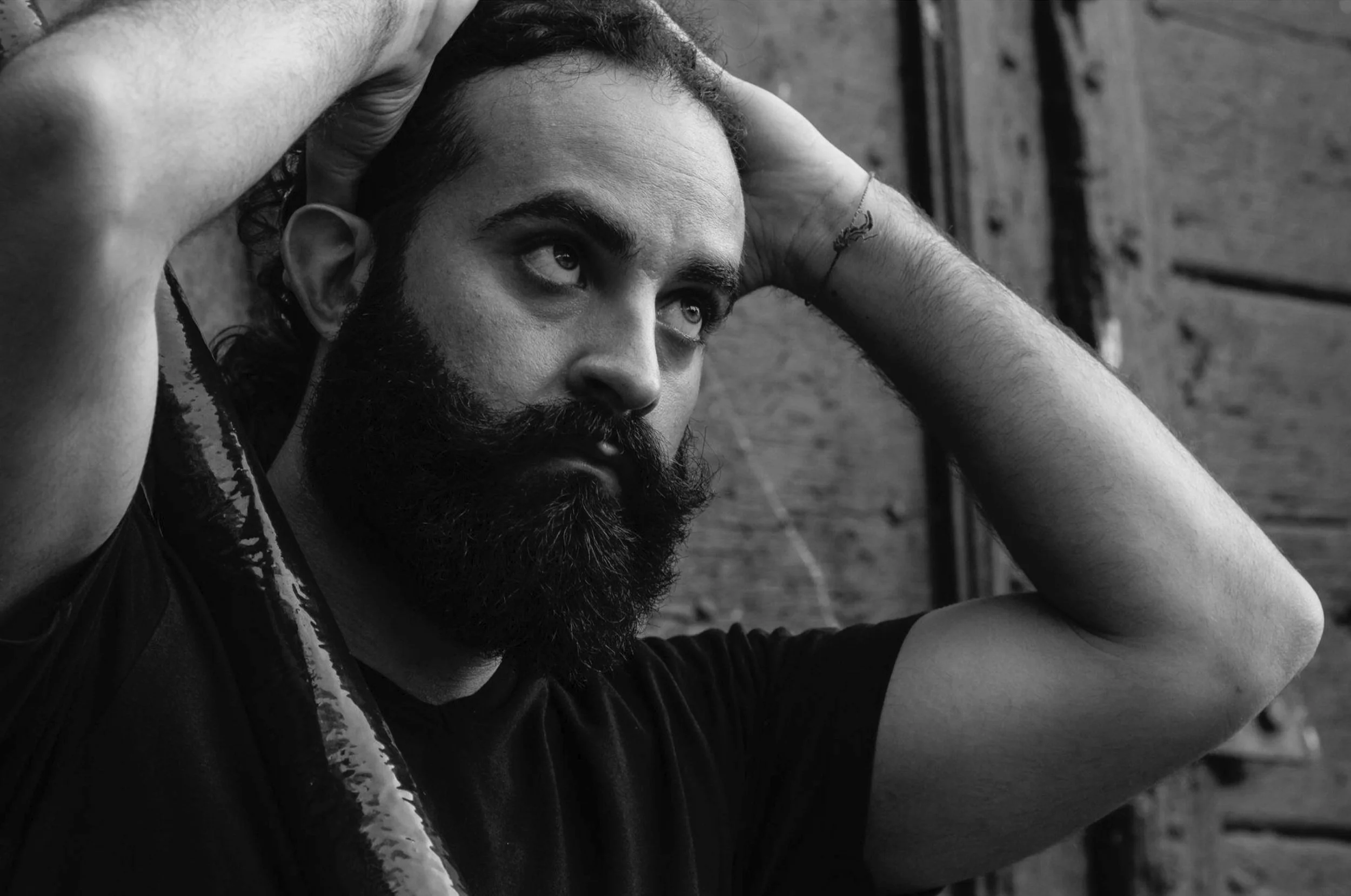

PH Cristina Peccioli 2015
“My music-making practice develops in situated deep listening occurrences,
where human, mechanical, electronic, and computational forces converge into a higher-order sonic generative system.”
Massimiliano Cerioni is an Italian composer, sound engineer, and artist, and a doctoral researcher at the Orpheus Instituut in Ghent. His practice spans composition, performance with custom systems and didgeridoos, video art, installations, electronic lutherie, creative coding, and audio software design with the project Culto. Musically, his aesthetic sits at the intersection of electroacoustic, ambient, dark ambient, noise, and drone. He also performs doom-drone/metal under the alias Granitaur. Collaborative projects extending beyond sound and music also represent an important part of his artistic production.
He studied Electronic Music with Michelangelo Lupone at the Alfredo Casella Conservatory of Music in L'Aquila, Italy, completing his Bachelor's and Master's in 2010 and 2016, both with honors. He interned at INA-GRM in Paris in 2009 and at GMEM in Marseille in 2012. In 2014 and 2015 he received two commissions from CRM of Rome. In 2015, he won First Prize at the National Arts Prize "Claudio Abbado" for electroacoustic music composition. In 2019, he held an artistic residency at EMS in Stockholm, supported by the ICC "C.M. Lerici". He moved to Berlin in 2021, where he undertook a residency at SCOPE BLN and co-founded the collective Wasch, presenting performances, exhibitions, and solo shows. In 2023, he joined Radius Collective, a US-based group of artists and designers that exhibits internationally. His works have been presented at venues and festivals including Berlin's CTM, ICMC Athens, Tempo Reale (Florence), Artescienza (Rome), Goethe-Institut Rom, Kunsttage Basel, Santa Cecilia Conservatory of Rome, and Rome Fine Arts Academy, among others. His music is released through Cyclical Dreams (Argentina) and Elli Records (France).
As an educator and an academic, he has taught Music Technology and Sound Design at public and private schools in Rome and Berlin. Building on two decades of work with the software Max, he taught programming for the online educational platform Music Hackspace in 2022. At the end of that year, he received a commission from Cycling'74 for a Max patch released on their blog. In 2024, he became a Max Certified Trainer, and in 2025 he co-founded the Max Berlin Network, dedicated to promoting the work of artists and creatives who use Max in Berlin, and to encouraging its practice among participants. In the same year, he brought his expertise with sound, programming, and AI to the Enacting Artistic Research project, in which, as a freelance researcher, he co-developed a system that uses AI to assess and describe perceptual qualities of sound. The results have been presented at the SAR Conference (Porto), the Web Audio Conference at IRCAM (Paris), the Orpheus Instituut (Ghent), the Pacesetters EU meeting (Málaga), and the European Researchers' Night (Rome). This background as a creative coder and audio programmer led him to the launch of his software project Culto in 2020, releasing Max for Live devices and audio plugins for experimental sound design. Since 2023 Culto has been distributed by Isotonik Studios.
In 2026, he was accepted as a doctoral researcher at the Orpheus Instituut, where he is developing his PhD within the ERC project Posthuman Music and the MetamusicX research cluster, both led by Paulo de Assis. His project examines how the coupled actions and decisions of humans, artificial intelligence, and sonic feedback systems allow emergent properties to arise in composition and performance contexts. From this assumption, he investigates how to redistribute agency in music-making via technology in compliance with the principles of posthumanism. This research includes the electronic lutherie projects he worked on for more than a decade with the support of the luthier Maurizio Palpacelli, the first of which was the feedback monochord Metastring, presented in 2017 at the Tempo Reale festival in Florence. His musical instrument design practice was formed through his training at the Centro Ricerche Musicali in Rome. There, he encountered the work of legacy pioneers of Rome's avant-garde music scene, such as Michelangelo Lupone with his Feed Drum, and Mario Bertoncini with the Eolian Harps.